Quiet on the Tarmac: A Confidentiality Checklist for UK Charter Buyers in 2026
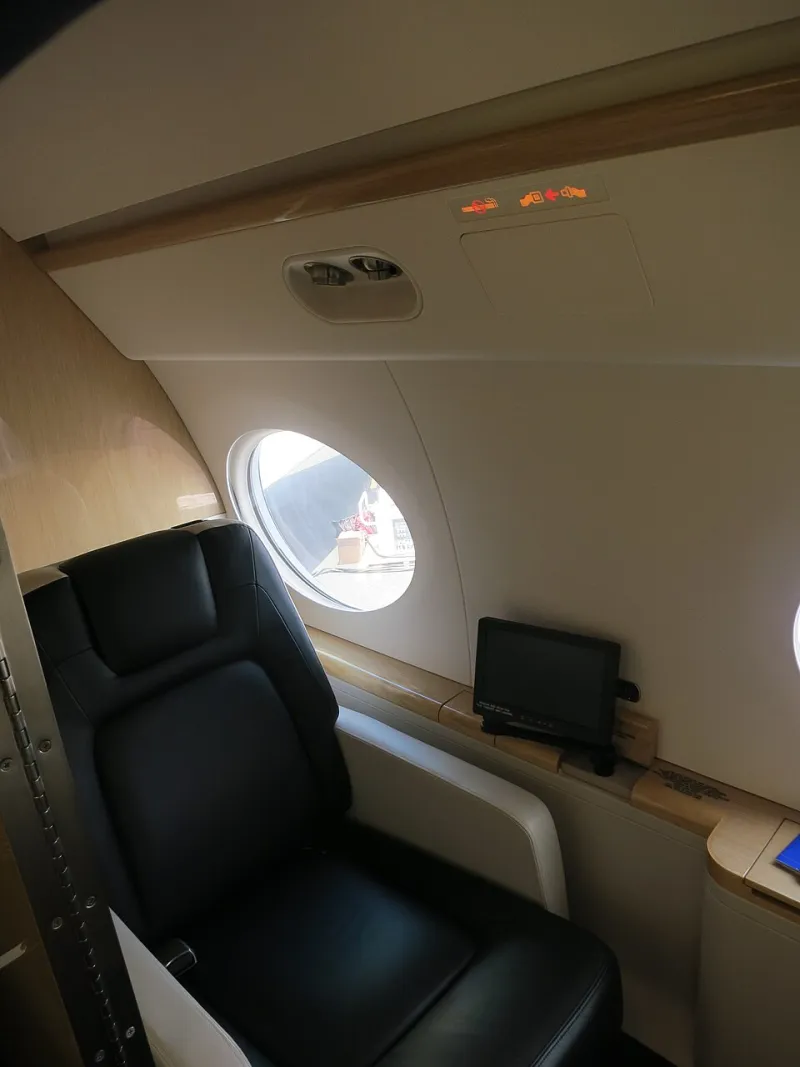
Photo: JetRequest.com, CC BY-SA 3.0, via Wikimedia Commons
Discretion is frequently presented as a mood: tinted windows, a quiet lounge, a crew that does not ask questions. For a UK executive who treats confidentiality as part of the ticket price, that is not enough. Discretion in private aviation is an operational discipline, and it can be audited before the aircraft is booked. The useful questions are contractual, procedural and, increasingly, digital.
Start with the Cabin, Not the Brochure
Cabin privacy is not binary. A light jet may offer a curtain rather than a fully partitioned cabin; a mid-size aircraft may have a forward galley and a separate club-four layout. Ask for the specific aircraft registration and cabin plan, not the category. If calls are part of the journey, confirm whether the cabin has a closed door, whether the satellite communications are voice-only or data-capable, and whether the crew can isolate the cabin from the flight deck intercom. Good practice is a written cabin protocol: who may enter, when service is suspended, and how confidential conversations are protected during taxi and turnaround. Ask, too, whether the operator permits photography or social media content from the cabin. A surprising number of discretion failures begin with a crew member's phone rather than a passenger's.
Crew Confidentiality and the Limits of the NDA
A crew non-disclosure agreement is a sensible starting point, but it is not a complete answer. Ask whether the NDA applies to direct employees, agency crew, contract pilots and cabin staff who may join at short notice. Ask how the operator trains crew on passenger recognition and non-engagement, and whether the training is refreshed. The better operators will have a written confidentiality policy that covers subcontractors and handling agents, not just the flight crew. They should also be able to explain what happens after a breach: who is notified, what is recorded, and how the passenger is informed. An NDA that is signed but never enforced is a marketing document, not a control.
Manifest Handling and Data Minimisation
The manifest is where discretion becomes a data-protection question. Under the UK GDPR and the Data Protection Act 2018, the passenger has rights, and the operator has obligations. Ask who receives the manifest, how it is transmitted, how long it is retained and whether it is shared with handling agents, ground transport providers or marketing partners. Good practice looks like a named data controller, a defined retention period, encryption in transit and at rest, and a written undertaking that passenger data will not be used for marketing without consent. For sensitive itineraries, ask whether names can be minimised on documents that do not require full passenger details, and whether the operator can provide a data processing agreement. If the answer is vague, the discretion premium is being charged without the corresponding controls.
Ground-Side Exposure
The most visible risk often sits outside the cabin. At Farnborough, Luton, Biggin Hill and London City, the ramp is not a private room. Ask how the operator and the FBO manage arrival and departure choreography: whether the car can drive to the aircraft, whether there is a side entrance, whether the crew will board before the passenger, and whether the handling agent has a photography policy. Paparazzi risk is not limited to celebrity clients; a competitor, a journalist or a disgruntled former associate can be waiting at the perimeter. Good operators will discuss timing, decoy movements where appropriate, and the use of discreet off-airport transfers. They will also tell you honestly what cannot be controlled. No one can guarantee anonymity at a busy London FBO on a Friday afternoon, but a professional operator can reduce the exposure.
Operator Data Practices
Ask how the operator's booking platform, app and customer relationship system handle itinerary data. Does the app require location permissions? Does the operator sell aggregated movement data? Are aircraft tracking websites able to identify the passenger, or only the aircraft? Some privacy claims are limited by public air-traffic data and aircraft registration rules. A credible operator will explain the difference between what can be withheld and what cannot. It should also have a breach notification procedure and a named point of contact for privacy questions. For UK buyers, the operator's UK GDPR posture is part of the service, not a back-office detail.
A Pre-Boarding Checklist
Before booking, ask for: the specific aircraft and cabin plan; the crew confidentiality policy and NDA scope; the manifest data flow and retention period; the FBO and ground transport protocol; the operator's photography and social media policy; the breach notification process; and written confirmation of what discretion commitments are contractual. Good looks like specific answers in writing, not a promise to be discreet.
Where Claims Deserve Scrutiny
Be sceptical of discretion claims that are not tied to a procedure. A website that promises absolute privacy is making a claim no operator can fully guarantee. A crew NDA that excludes agency staff is incomplete. A data policy that allows marketing use is not a privacy policy in the sense the buyer intends. The right question is not whether an operator is discreet, but which parts of the journey are covered by a written control, who is accountable, and what happens when the control fails. In 2026, the discretion premium is still worth paying, but only when it is itemised.