Buying Back Tuesday: The Central European Routes Where Charter Still Earns Its Keep
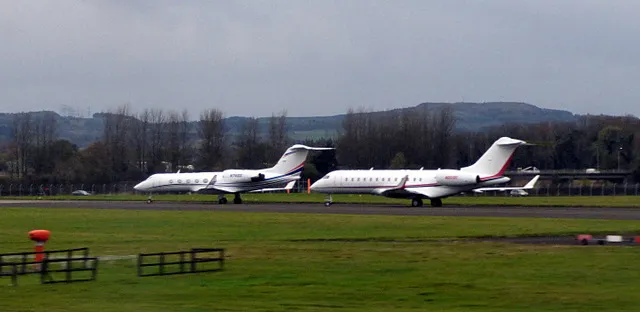
Photo: Thomas Nugent , CC BY-SA 2.0, via Wikimedia Commons
Central Europe is where the case for private charter is hardest to argue and easiest to oversell. The distances are short enough that airlines compete hard on frequency, and long enough that the hours saved, where they exist at all, are genuine rather than rhetorical. An operator who promises that a jet to Prague will transform a finance director's week has probably not read a Monday morning timetable. One who says the same of Sofia without qualification has probably not looked at the return leg.
What follows is a route-by-route assessment of the five Central European destinations that generate most UK charter enquiries, judged on a single question: does the aircraft buy back a working day?
First, agree what a day is worth
The useful measure is not block time but cabin door to first handshake. That figure is made up of three variables: how quickly you can reach the UK departure airport, how long the terminal takes, and what the schedule does to you on the way home. The inbound leg is where charter most often wins, because airlines structure their timetables around the needs of the destination city, not the departing executive.
A second variable is frequently ignored. A private aircraft lets a party of five travel with the documents, prototypes or samples that would otherwise need a courier or a freight booking. Where that is the constraint, the time argument is almost secondary.
Prague: the schedule usually wins, the return sometimes does not
London to Václav Havel is around 1 hour 50 minutes in the air, and there are enough daily departures from Heathrow, Gatwick, Luton and Stansted that a business-class seat is rarely hard to find. On a typical Monday the airline passenger leaving Heathrow at sevenish is in the city before eleven. A light jet departing Farnborough at six thirty achieves perhaps forty minutes on that, and gives away some of it on the drive from Václav Havel into the centre.
Where charter earns its premium is the return. The last useful scheduled departure often falls in the late afternoon, which forces either a wasted morning or an unnecessary overnight. A midsize aircraft waiting at Prague can leave at seven in the evening and have you at Farnborough before nine GMT. For a single-meeting trip, that is an expensive convenience. For a two-day negotiation, it is a recovered Tuesday.
Warsaw: Modlin is the tell
Warsaw is the clearest example of an airport-choice argument. Low-cost capacity is concentrated at Modlin, roughly forty kilometres north of the centre, which adds an hour of ground transfer to a trip that already involves a two-hour-plus flight. Business traffic tends to use Chopin, where the general aviation apron and handling are competent but not instantaneous.
Charter from Luton or Biggin Hill into Chopin gives a genuinely civilised arrival, and the private terminal clears a UK passport holder in minutes. Against that, British Airways and LOT both run early Heathrow departures that arrive before eleven. The honest verdict: charter wins on the return and on multi-stop itineraries that continue to Łódź, Poznań or Gdańsk, where the scheduled network thins out sharply.
Budapest: the confidentiality dividend
Ferenc Liszt handles business aviation well, and the city is close enough to the airport that a nine-thirty arrival is a ten o'clock meeting. Scheduled capacity from London is reasonable but concentrated in the middle of the day, which is the worst possible window for a morning meeting and an afternoon return.
Budapest is also where the non-time arguments carry most weight. A board meeting with papers that cannot be left in a hotel safe, or a party that needs to move between Budapest and Vienna on the same day, is a charter trip regardless of the timetable. Judged purely on hours saved, the case is moderate. Judged on control, it is strong.
Bucharest: the long leg that rewards the day return
Around three hours and twenty minutes in block time, with limited direct capacity from London and a schedule that makes the same-day return difficult on airlines. Henri Coandă is the airline airport; Aurel Vlaicu, closer to the northern business districts, is the more useful arrival point for a jet and is well served by local handlers.
This is the route where charter most reliably pays. A six-thirty departure from Luton puts you in Bucharest before midday local time, and a six o'clock evening departure brings you home the same night. The alternative involves either an overnight or two very long days. For anyone valuing a night at home, the arithmetic is straightforward.
Sofia: the edge of the envelope
The longest of the five at roughly 1,250 nautical miles. A super-midsize aircraft does it comfortably; a light jet does it with a fuel stop or a payload penalty, and winter headwinds make that worse. Scheduled direct capacity from Heathrow exists but is thin, and the connections through Vienna or Munich are unpredictable in December.
Romania and Bulgaria have both been fully inside the Schengen area since the start of 2025, which has simplified arrivals noticeably — though non-EU nationals should still expect to be processed and should not assume a private terminal removes that step. Sofia rewards charter for the same reason as Bucharest, more so, because the airline alternative costs a full day in each direction.
Aircraft and crew fit
Prague, Warsaw and Budapest sit comfortably inside the range of a Citation CJ3+ or Latitude, and a light jet keeps the price sensible. Bucharest and Sofia belong to the Praetor 600 and Challenger 350 class, particularly when a full complement of passengers is travelling with baggage.
Crew duty is the quiet constraint on the longer legs. A same-day return to Sofia can approach eight hours of block time, which leaves little margin for a two-hour slip at either end. Buyers should ask explicitly whether the operator has built any discretionary buffer into the flight duty period, and what happens if it is exhausted.
Where charter loses
It loses on the single meeting with a flexible diary. It loses when the destination has a dense morning schedule and the return can be taken the following day. And it loses whenever the aircraft sits on the ground for six hours to serve one hour of flying, because you are paying for the wait.
The verdict
Ranked by hours genuinely recovered: Bucharest and Sofia first, Warsaw second, Budapest third on time and higher on discretion, Prague last on pure arithmetic. Any UK buyer considering the eastbound run should price the airline alternative honestly — including the overnight, the ground transfer and the value of the evening at home — before deciding that the jet is a luxury rather than a calculation.