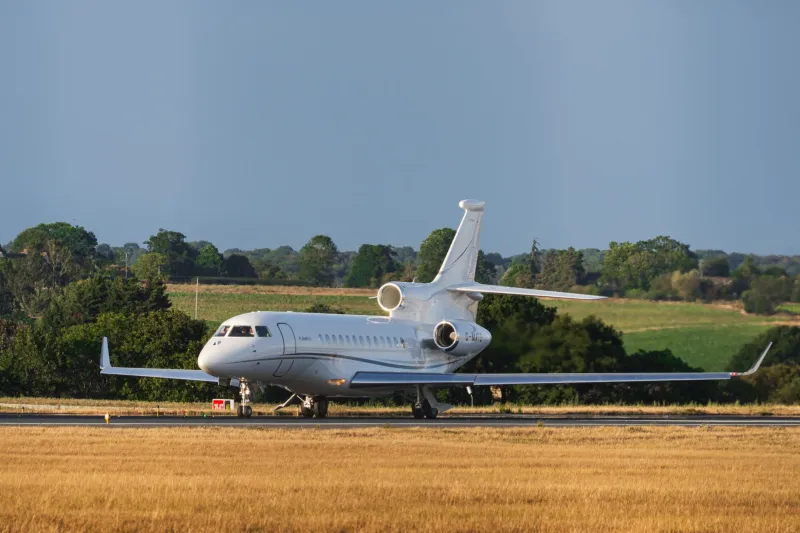
Desk to Desk: Auditing the Real Time Dividend of Private Charter on Four Business Routes

Photo: business executives boarding private jet at Farnborough Airport, via www.ringcentral.com
The case for private aviation is usually made in comfort. The stronger case is made in hours. Yet the hour saved is rarely counted with the same rigour as the fare paid. A charter quote is a single number; the alternative is a chain of small frictions — the drive, the queue, the bag, the wait, the transfer — each of which is easy to ignore individually and expensive in aggregate.
This is an attempt to count them. Using a representative weekday and a London office as the origin, we have modelled door-to-door journey times on four routes that dominate the UK executive's European diary: Geneva, Frankfurt, Edinburgh and Dublin. The comparison is private charter against the best practical scheduled alternative — business class where it exists, flexible economy where it does not. The figures are illustrative, not audited; the method, however, is the point.
The hidden hour before departure
Every scheduled journey contains an hour that never appears on the ticket. It is the buffer between leaving the office and settling into the seat: the margin for traffic, the recommended check-in, the walk to the gate, the boarding call that arrives earlier than necessary. For a short-haul business-class passenger with a checked bag, ninety minutes at the airport is a reasonable planning assumption; with hand baggage only and a fast terminal, sixty. Neither is the worst case, and both are routinely exceeded.
Private charter compresses this block to fifteen or twenty minutes at an FBO. But it does not eliminate the drive, and it can lengthen it. Farnborough, Biggin Hill and Luton are not always closer to a Mayfair desk than Heathrow. The honest comparison starts at the office door, not the departure gate, and must include the last-mile transfer at the other end — where a scheduled airport may be closer to the city centre than a quieter alternative.
London to Geneva: the day-trip case
Geneva is the route on which charter most often justifies itself, because the alternative is a day that cannot be done. A morning departure from Heathrow with a 07:00 check-in means leaving central London at 05:15. The flight is 1 hour 40 minutes; arrival, bag reclaim and a transfer to the international quarter add a further hour. Door-to-door, roughly five and a half hours.
By charter from Farnborough, the same executive leaves at 07:00, arrives at the FBO at 07:20, departs at 07:45 and is in a Geneva meeting room by 10:15 local — about three hours fifteen minutes. The saving is two hours or more each way, and it turns an overnight into a single day. Whether that is worth a premium of £8,000 to £12,000 return depends on what the day is for; for four people closing a transaction, the per-person arithmetic is less alarming than it first appears.
London to Frankfurt: the efficient alternative
Frankfurt is a test of charter's honesty. The scheduled product is strong: frequent departures from Heathrow, a business class that works, and an airport with a train station beneath it. Door-to-door is about five hours. Charter from Luton or Farnborough saves perhaps ninety minutes to two hours, not because the flight is faster but because the ground is shorter.
The saving is real but narrower, and it is vulnerable to the one thing charter cannot control: weather and slot pressure at a congested continental hub. On a bad day, the scheduled passenger absorbs delay in a lounge; the charter passenger absorbs it in a smaller FBO with fewer alternatives. The arithmetic still favours charter for a multi-meeting day, but the margin is thinner than the brochure suggests.
London to Edinburgh: where the rule breaks
Edinburgh is the route on which the case for charter most often fails, and it is worth saying so. The flight is barely eighty minutes. London City to Edinburgh is a shuttle; Heathrow is frequent. With hand baggage and an early arrival, a scheduled door-to-door journey can be completed in three and a half hours. The train, at four hours twenty from King's Cross to Waverley, is competitive for anyone who can work on it.
Charter from Farnborough or Biggin Hill saves perhaps forty-five minutes to an hour — sometimes less, once the drive to the FBO is counted. A premium of £6,000 to £9,000 for an hour is difficult to defend on time alone. It can be defended on schedule: the ability to leave after the meeting rather than at the airline's convenience, or to reach a destination such as Glenrothes or Aberdeen without a connection. But the time dividend, narrowly counted, is modest.
London to Dublin: the reliable saving
Dublin behaves like Geneva on a shorter sector: the scheduled alternative is adequate, the charter saving is consistent, and the day trip is viable. Door-to-door scheduled is about four and a half hours; charter is three. The saving of ninety minutes each way is enough to make a morning meeting and an afternoon return realistic, provided the aircraft is positioned sensibly and the Dublin FBO is not congested.
The caveat is the return. Dublin's evening scheduled frequencies are good; a charter that must depart before a crew duty limit or a night-stop charge can erode the advantage. The saving is real, but it is a day-trip saving, not a daily one.
The arithmetic that decides
The time dividend is not a constant. It scales with distance up to a point, then collapses as the scheduled alternative improves. On a ninety-minute sector between two well-served cities, charter buys convenience and schedule control more than hours. On a two-hour sector to a city where the scheduled arrival is a long transfer from the meeting, it buys half a day.
A workable rule is this: count the door-to-door hours, not the flight time, and value the saving against the premium. If the premium is £8,000 and the saving is four hours on a return trip, the cost is £2,000 per hour — or £500 per person-hour for four travellers. That may be rational for a deal, and irrational for a routine visit. The number is not a verdict; it is a discipline.
Private aviation's real product is not speed. It is the removal of uncertainty and the recovery of the edges of the day — the early departure that makes a meeting, the late return that makes a dinner. The ninety-minute rule, if there is one, is not about flight time at all. It is about whether the hours saved are hours you would otherwise lose. Count them honestly, and charter will sometimes fail the test. It is more useful, and more credible, to say so.