Above the Snowline: The 2026 Arithmetic of Ski-Weekend Charters from London
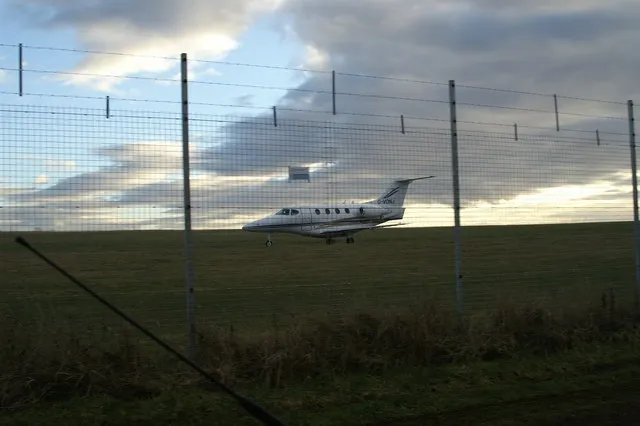
Photo: Adrian and Janet Quantock, CC BY-SA 2.0, via Wikimedia Commons
The pitch is always the same: leave the office at four, be in the chalet for supper. It is achievable. It is also, on perhaps one weekend in three between January and March, quietly unachievable — and the difference between the two outcomes is almost never the aircraft. It is the arithmetic done in November, before the first booking is confirmed.
Two Ledgers, Not One
Most ski-weekend charter decisions are made on the outbound leg. That is a mistake. The round trip has two separate risk profiles, and they are rarely symmetrical.
The Thursday-evening outbound is a congestion problem. You are competing for a departure slot at a London-area airport at the same time as every other Friday-adjacent movement, and you are arriving into an Alpine field that may already be closing for the night. The Sunday-evening return is a weather and duty problem. Crew hours have been running since the Thursday, the French and Swiss fields have absorbed two days of heavy traffic, and a snow event in the Tarentaise will send every based aircraft scrambling for the same de-icing rig.
A sensible buyer prices both legs, and prices the fallback on both legs, before agreeing a figure.
Choosing the Airfield by Valley, Not by Reputation
Geneva has the widest opening hours, the deepest handling infrastructure and the best road link to the Portes du Soleil, Chamonix and Villars. It is also, in February, the single most congested business aviation environment in continental Europe. Slots are coordinated, the general aviation terminal fills, and a two-hour departure delay on a Sunday afternoon is not unusual.
Chambéry is the natural door to the Trois Vallées, Courchevel, Méribel and Val Thorens. It is short, snow-prone and, on peak Saturdays, operationally stretched. Grenoble serves the same valleys from the south with a longer runway and its own constraints. Lyon is the reliable fallback when both are unavailable, at the cost of roughly two hours by road into the high Tarentaise.
On the Swiss side, Sion is the efficient answer for Verbier and the Valais, but it demands crew qualification, prior permission and a slot, and it does not welcome a late arrival. Samedan, at roughly 1,700 metres, is the closest field to St Moritz and the most performance-sensitive in the region; only aircraft with genuine high-altitude capability and appropriately trained crews should be considered, and its operating window is narrow in midwinter. Innsbruck and Salzburg cover the Austrian resorts well, though Innsbruck's approach procedures and noise restrictions require an operator who flies there routinely rather than occasionally.
The practical rule is straightforward: name two airfields per valley before you book, and check that the operator has actually operated into the second one this season.
Aircraft Selection: Bay Volume Before Cabin Comfort
Ski baggage is the constraint that catches people out. A family of four with two pairs of skis each, boots, helmets and hard cases will often exceed the hold volume of a light jet long before it exceeds the seat count.
For two to four passengers with modest luggage, a Phenom 300E or Citation CJ3/CJ4 will do the job on the French fields. Add a fifth passenger with a full ski bag and the honest answer is a midsize cabin — a Citation XLS+ or Learjet 75 — or a light jet with a belly pod, which is worth asking about explicitly rather than assuming.
For six to eight passengers with serious kit, a super-midsize such as a Challenger 350 or Praetor 600 is the realistic minimum. For Samedan or a high-altitude departure in warm spring snow, the Pilatus PC-24's short-field and unpaved-capable performance explains why it has become so common on Swiss winter work.
Ask for hold volume in cubic metres and door dimensions, not adjectives.
Slots, PPR and the Saturday Problem
Peak-season Alpine flying is a permissions exercise. Expect prior permission requirements at several French fields, slot coordination at Geneva and Samedan, and departure slot restrictions from UK airports during the morning and evening banks.
Three questions separate a professional operator from an optimistic one. First, is the slot held or merely requested? Second, what is the airport's closing time in local time on the relevant date, and does the schedule still work if departure slips forty minutes? Third, who absorbs the cost if a slot is lost — the buyer, the operator, or neither?
A charter that lands twenty minutes before a field's night closure has no margin. Buyers should treat any such schedule as a warning rather than a bargain.
Weather, De-Icing and the Honest Contingency
Budget a de-icing allowance of roughly £1,500 to £4,000 per event on a midsize aircraft, and accept that in a genuine snow cycle it may be applied at both ends. Fuel for a destination alternate is a real cost, not a theoretical one: the standard legal alternate for Chambéry on a bad afternoon may be Lyon or Geneva, and that fuel is carried whether or not it is burned.
Then there is the human arithmetic. If a Sunday return slips past the crew's duty limit, the operator must either position a fresh crew or the passengers must overnight. Either outcome costs more than the difference between a good charter and a cheap one. Inquire, in writing, what the operator's policy is on crew duty overruns and who pays for the hotel.
Indicative Budgets for the 2026/27 Season
Assuming a London-area departure and a French Alpine arrival, a Thursday-out, Sunday-back rotation typically sits in the following bands, before de-icing, ground handling at the resort end and higher-rate Air Passenger Duty, which applies to aircraft of 20 tonnes or more with fewer than 19 seats and which rose again on 1 April 2026.
- Light jet, four passengers, Chambéry or Geneva: broadly £18,000 to £25,000 return.
- Midsize, six passengers, with oversized baggage: broadly £26,000 to £35,000 return.
- Super-midsize, eight passengers, Sion or Innsbruck: broadly £38,000 to £50,000 return.
Add handling, Alpine surcharges, crew overnight costs where the schedule requires one, and a contingency reserve of perhaps ten to fifteen per cent. The reserve is not pessimism; it is the price of a schedule that survives a bad forecast.
The Door-to-Door Honesty Test
A like-for-like comparison against scheduled flying should count the same things on both sides. Private: fifty minutes to Farnborough, fifteen minutes through the terminal, one hour forty to Chambéry, twenty minutes to the car, two hours to Val d'Isère — a little over five hours, with the caveat that a February Sunday can add ninety minutes on the road.
Scheduled: an hour to Heathrow, two hours at the airport, one hour forty to Geneva, forty-five minutes of arrivals and baggage, then the same two-and-three-quarter-hour transfer. Seven and a half hours is a fair figure, and the private option typically saves two to two and a half hours each way.
That saving is real. It is simply not the four hours that glossy brochures imply — and a buyer who knows the true figure negotiates better.
Before You Commit
Confirm the second-choice airfield and the operator's recent experience there. Ask for the slot status in writing. Establish the latest arrival time the destination will accept and work backwards with a buffer. Agree the de-icing and alternate-fuel treatment. Confirm hold volume against your actual luggage. And diarise a decision point seventy-two hours out, when a forecast becomes credible enough to move the booking from Thursday to Friday morning at modest cost rather than at painful cost.
Snow is not an emergency. It is a seasonal certainty. The charter that works is the one planned as though the weather will misbehave.